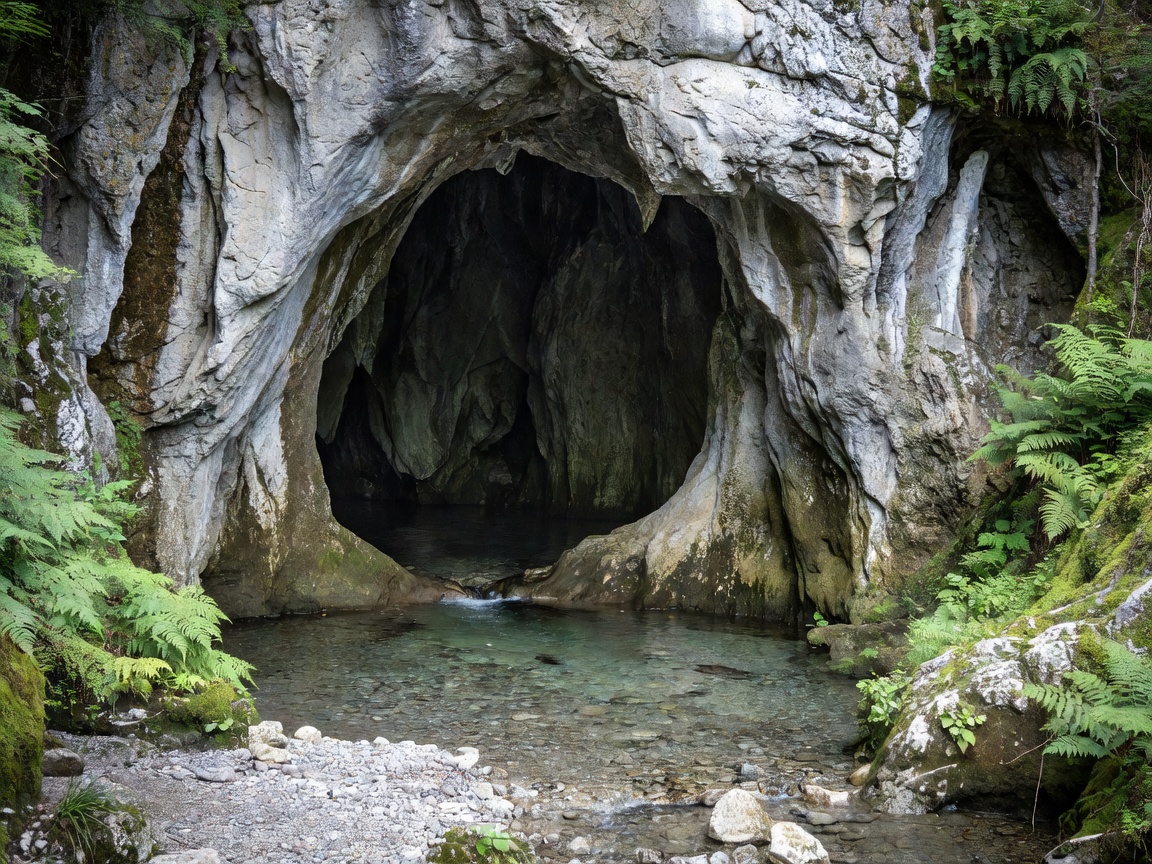
Geological Context: The Gorjanci Piedmont Fault
While the classical karst plateau of southwestern Slovenia features extensive dry plateaus and massive chasms, southeastern Slovenia (Dolenjska) presents a distinct morphology: "shallow" or "covered" lowland karst. Kostanjevica Cave (Kostanjeviška jama) lies just outside the historic island town of Kostanjevica na Krki, directly at the foot of the northern slopes of the Gorjanci mountain chain.
Here, Triassic and Jurassic carbonate rocks are down-faulted against impermeable Neogene sedimentary layers of the Krka River plain. Precipitation falling on the high forested ridges of Gorjanci sinks rapidly through tectonic joints and faults, traveling north underground until encountering the impermeable sediments of the plain. This geological constriction forces groundwater to pool under pressure and discharge through spring caves at the piedmont margin.
Discovery by Catastrophic Karst Inundation
The entrance to Kostanjevica Cave was discovered relatively recently compared to Postojna or Škocjan. In the spring of 1937, unprecedented cloudbursts over the Gorjanci massif saturated the subterranean conduits. The trapped hydrostatic pressure built to such intensity that subterranean waters violently breached the surface gravels and soil cover, blowing out a massive sink of sediment and opening a gaping cavern portal.
Local speleologists soon explored the newly opened cavity, cataloging approximately 2 kilometers of passages. The cave is traversed by an active subterranean brook that swells dramatically during spring snowmelt and torrential autumn rains.
Morphology: Calcite Canopies and Scalloped Walls
The morphological features inside Kostanjevica Cave offer clear visual evidence of dynamic water movement under alternating atmospheric and flooded (phreatic) regimes:
- Current Scallops: The limestone walls are sculpted with asymmetrical concave hollows (scallops). Their size and orientation allow geomorphologists to precisely calculate the velocity and direction of prehistoric and modern subterranean flood currents.
- Sinter Canopies & Stalactites: In upper passages elevated above normal flood levels, water dripping from the Gorjanci forest has created dense clusters of stalactites, stalagmites, and delicate draperies tinted yellow, ochre, and deep reddish-brown by humic acids leaching from the overlying soils.
- Gravel Banks and Sorting Channels: Coarse chert and dolomite gravels transported down from the mountain interior carpet the lower stream bed, demonstrating high-energy mechanical erosion during peak discharges.
Spring Hydrology and the Krka Floodplain
The waters emerging from Kostanjevica Cave join a network of karst resurgences, including the Obrh and Studena springs, which feed directly into the Krka River. The Krka is famous for its extensive active calc-tufa barriers that create cascading river waterfalls across the lowland plain.
Because the underground recharge area spans both protected state forests and lower agricultural zones, hydrogeologists continuously monitor Kostanjevica's water quality. Fluorescent dye-tracing tests have revealed flow velocities through the Gorjanci conduits ranging from 20 to 120 meters per hour, depending on antecedent rainfall conditions.
Field Comparison: Lowland Springs vs. Highland Karst Systems
Understanding the distinction between highland infiltration caves and lowland piedmont resurgences is fundamental to regional karst resource management.
- High responsiveness to localized precipitation events
- Direct link to alluvial floodplain ecosystems
- Compact, easily walkable horizontal passage layout
- Clear display of hydraulic back-flooding scallops
- Tours abruptly suspended during severe flash floods
- Periodic sediment accumulation requiring path clearing
- Smaller total chamber volume than Classical Karst caves
- Vulnerability to pesticide and nitrate seepage from slopes