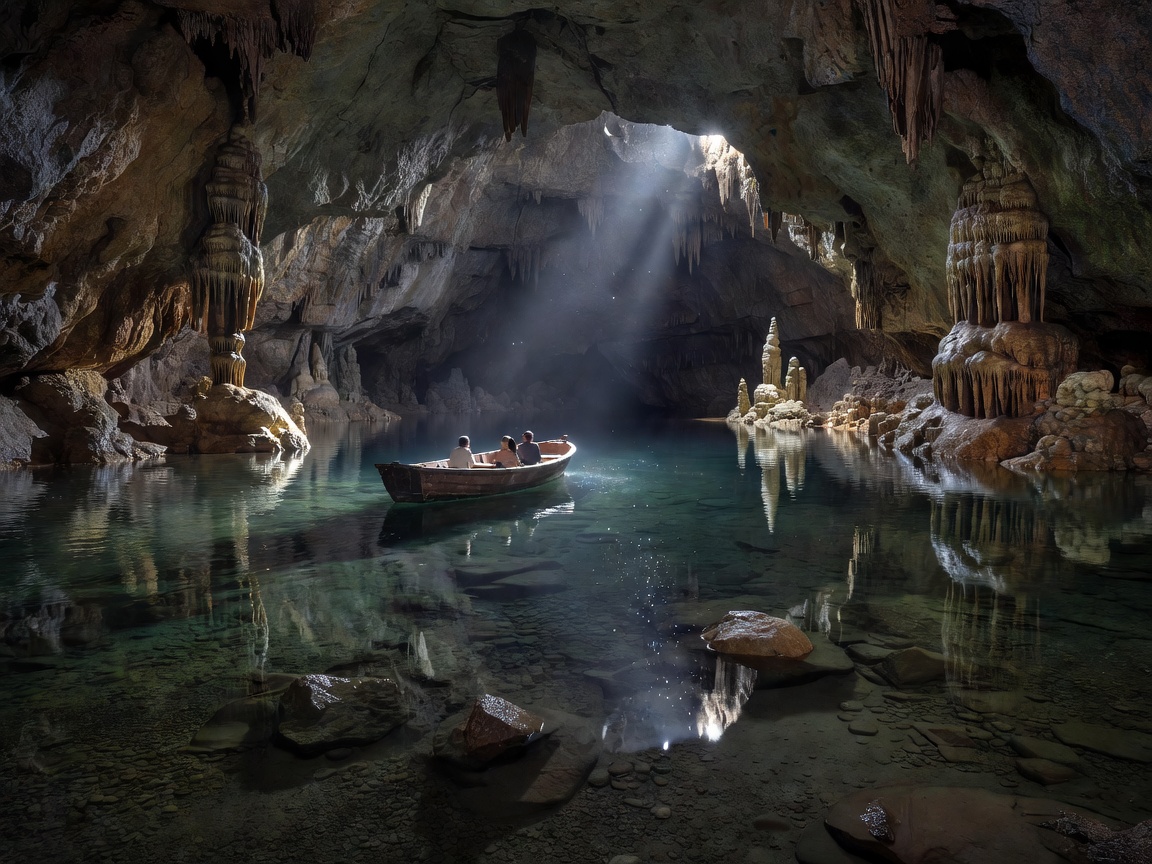
Pristine Karst Hydrology & Calc-Tufa Dams
Situated between the intermittent Lake Cerknica (Cerkniško jezero) and the high karst plateau of Bloke, Križna Jama (Cross Cave) stretches for 8,273 meters. Unlike industrialized show caves with concrete paths and permanent electric lights, Križna Jama has deliberately been kept in an un-electrified, virgin state to protect its extraordinarily sensitive calc-tufa (rimstone) structures.
The water sinking from the Bloke plateau percolates slowly through thick dolomite and limestone strata, dissolving minerals along its path. Inside the cave, the underground stream flows over natural obstacles where carbon dioxide degasses from the turbulent water. This chemical precipitation prompts calcium carbonate to crystallize, gradually forming living rimstone dams (gours). Over millennia, these dams have grown to heights of up to several meters, impounding a succession of 22 subterranean lakes of crystal clarity and vivid emerald hues.
Because calc-tufa grows at mere fractions of a millimeter per year and is structurally porous and brittle, foot traffic along the dams would cause irreparable fracturing. As a result, speleologists and visitors navigate the lake system solely by non-motorized rubber inflatable rafts, taking care not to scrape the underwater weir crests.
Paleontological Heritage: The Cave Bear (Ursus spelaeus) Necropolis
In addition to its aquatic waterways, the dry chambers of Križna Jama represent one of Europe's richest paleontological deposits for the extinct Late Pleistocene cave bear (Ursus spelaeus). During the Würm glaciation (between 40,000 and 100,000 years ago), these colossal plant-and-meat-eating mammals entered the cave's initial dry galleries to hibernate through harsh winters.
Those individuals that perished during hibernation were preserved under blankets of calcium carbonate and clay deposits. Early excavations in 1878 by Ferdinand von Hochstetter recovered thousands of fossilized bones, skulls, and giant canine teeth. Today, visitors traversing the dry branch can still observe large skeletal clusters, polished wall surfaces ("Bärenschliffe") where bears repeatedly rubbed their fur against limestone corners, and distinct hibernation wallows (bear nests) indented into the sediment floor.
World-Class Biospeleological Biodiversity
In global speleobiological literature, Križna Jama ranks among the four richest caves in the world in terms of troglobiotic aquatic species diversity. More than 45 distinct specialized troglobitic and stygobitic taxa have been documented within its passages.
The subterranean food web relies completely on organic detritus washed in from the Bloke plateau. Tiny blind amphipods (Niphargus), subterranean isopods (Monolistra), microscopic gastropods, and the apex cave predator, the olm, inhabit the interconnected pools and gravel bars in stable numbers.
Conservation Protocol: Regulated Access Regimes
To prevent microbiological contamination and algae growth (lampenflora), Križna Jama enforces strict visitor quotas under the management of the Križna Jama Cave Lovers Association.
- Duration: 1.0 to 1.5 hours
- Equipment: Rubber boots and handheld halogen torches supplied
- Distance: Initial dry passage, cave bear bone exhibits, and first lake boat ride
- Impact: Minimal, restricted to hardened sediment path
- Duration: 4.0 to 7.0 hours
- Annual Cap: Strict statutory limit (maximum 1,000 visitors per calendar year)
- Requirements: Advance multi-month permits; low water levels required
- Navigation: Continuous portage of rafts over calc-tufa barriers