Hydrological Origin & The Pivka River Conduit
The genesis of Postojna Cave is inextricably tied to the Pivka River, an allogenic stream draining the non-permeable flysch deposits of the Pivka Basin. When this acidic, sediment-bearing river impinges on the Cretaceous limestone beds of the Postojna threshold, it descends abruptly underground through a swallow hole (ponor) situated at 511 meters above sea level. Over an estimated period of two to three million years, the water has carved multiple horizontal cave levels corresponding to distinct regional base level drops during the Quaternary period.
The system is not an isolated single bore; it consists of five interconnected caves: Postojna Cave proper, Otoška Cave, Magdalena Cave, Pivka Cave, and Black Cave (Črna Jama). Water traveling through these subterranean conduits traverses a subterranean siphon system before resurging over ten kilometers to the north as the source of the Unica River in the Planina Polje basin.
Subterranean Engineering: The World's First Speleo-Railway
Postojna represents an extraordinary intersection of natural speleology and industrial engineering. While early human exploration dates back centuries—inscriptions on the walls date to 1213—the system was opened to formal scientific study and public visitation following the discoveries of local guide Luka Čeč in 1818.
To make deep chambers accessible without exhausting days of foot navigation over boulder chokes, the world's first underground railway was laid in 1872. Initially pushed manually by guides, the system transitioned to steam locomotion briefly, and subsequently to electric locomotives in the early twentieth century. Currently, a dual-track 620-millimeter narrow-gauge line transports visitors 3.7 kilometers into the karst interior, terminating near the "Great Mountain" (Velika Gora) collapse chamber.
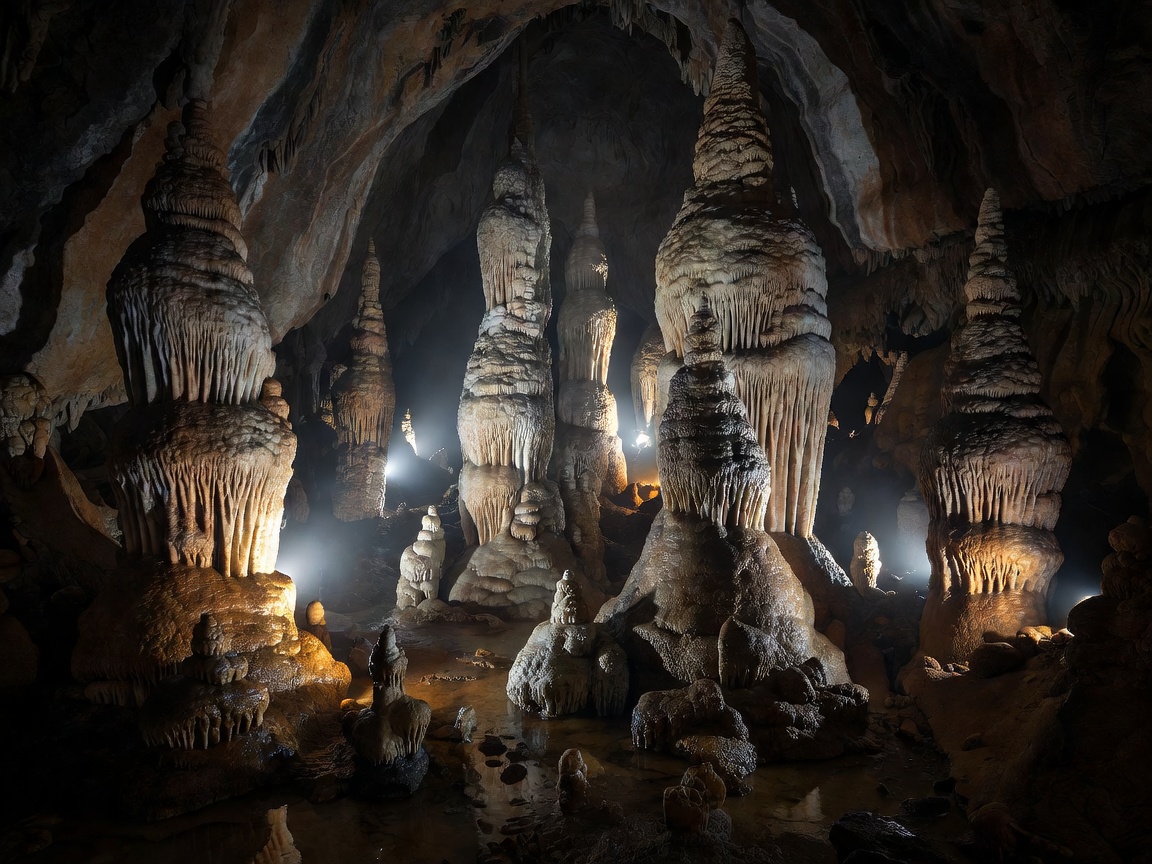
Morphological Features: Stalactites, Calcite Curtains & The Brilliant
The cave passages exhibit nearly every classical speleothem typology cataloged in geomorphological literature:
- Straw Stalactites: Slender tubular formations hanging along ceiling fractures, fed by slow, continuous drip water saturated with calcium hydrogen carbonate.
- The Brilliant (Briljant): A landmark five-meter-tall pure white stalagmite formed by uniform water dripping from a high vault, creating an uninterrupted calcitic coat of extreme purity.
- Draperies and Flowstones: Wavy curtain-like ribbons created as mineralized water trickles down slanted limestone overhangs, tinted with iron oxides (reds and ambers) and organic acids.
- Sedimentary Alluvial Infill: Fine clays and gravel beds deposited during prehistoric Pivka River back-flooding episodes, critical for paleoclimate reconstruction.
Speleobiology: The Proteus anguinus Ecosystem
Postojna is celebrated globally as the cradle of biospeleology. The subterranean environment maintains a constant year-round temperature between 9°C and 10°C, high relative humidity near 100%, and total photic absence. Under these conditions, evolution has yielded specialized troglobites—animals strictly adapted to underground life.
The flagship species is the olm (Proteus anguinus), a neotenic blind subterranean salamander reaching up to 30 centimeters in length. Characterized by fleshy pale-pink skin, underdeveloped eyes covered by epidermis, elongated snouts with sensitive chemoreceptors, and external bright red gills, the olm can endure years without food due to its minimal metabolic rate. Beyond the olm, over 150 animal species inhabit the Postojna-Planina cave system, including the blind slender-neck beetle (Leptodirus hochenwartii), discovered here in 1831.
Field Comparison: Postojna Cave vs. Typical Alpine Potholes
Unlike high-elevation Alpine vertical shafts (characterized by near-freezing drip temperatures, treacherous ice cascades, and vertical pitches), the Postojna network operates as a horizontal multi-tiered through-flow cave with broad footings and reliable microclimatic equilibrium.
- Massive cross-sectional gallery chambers
- Highly developed electric rail access
- Pivka River hydrological connectivity
- Dedicated subterranean vivarium research facility
- High visitor density requiring strict lampenflora mitigation
- Periodic flash floods in lower Pivka channels
- Microclimate shifts near artificial access tunnels
- Delicate calcite formations sensitive to airborne dust